ShareThis

Showing posts with label Coming Out Lesbian LGBT Pride. Show all posts

Monday, September 13, 2010

Katy Perry wants to sleep with X Factor's Cheryl Cole

American singer Katy Perry has sensationally revealed that she wants to sleep with X Factor judge Cheryl Cole.


The I kissed A Girl star, who was recently a guest judge on the show in Dannii Minogue's temporary absence, said: "I adore Cheryl, she's amazing."


She also added that if she weren't with British comedian Russell Brand, she'd want to be in a relationship with the Girls Aloud star.

"I'm very happy with my own English stud but if I wasn't with him I'd be trying to date Cheryl," she added.

"Nobody should be as beautiful as she is. I know people get turned on by Simon's power but if I was single I'd rather sleep with Cheryl than Simon."

Perry's debut single, I Kissed A Girl, topped the charts in more than 30 countries, including America, Australia, Canada, Ireland and the UK.

Wednesday, August 25, 2010

Miley Cyrus' LOL: Drinking, Drugs, Lesbian Kisses and More [Video]

We all get that Miley is no longer a Disney darling, but it seems things have intensified in a bad way. LOL is the name of Miley's movie where she stars with Demi Moore as a rebellious teen named Lola.
20 June 2010 - Toronto, Ontario, Canada - Miley Cyrus. 21st Annual MuchMusic Video Awards held at MuchMusic HQ. Photo Credit: Brent Perniac/AdMedia

What can be so bad about a rebellious teen? Well, nothing and everything depending on how rebellious that teen is. In Lola's case, this is clearly not a film you will want to take your child to if they are under the age of 16, and even then you might want to hold off a year or two until they can decide on their own to see it.
According to Hollywood Life, in the movie Lola looses her virginity, talks about sex incessantly, smokes pot, drinks heavily, and also accidentally shows her mom - played by Demi - her Brazilian wax. If all that wasn't bad enough, Lola also makes out with not one, but two female friends. We get it, Miley. You aren't a kid anymore.
"You're my daughter," Demi tells Miley at one point, "And I won't let you turn into a porn star!" Good for Lola's mom. Now why won't Miley's parents tell her the same thing? It doesn't matter if it's in film and fake. This is the image she's presenting to her fans, and her parents should be ashamed of themselves for allowing Miley to take this kind of role. Now more than ever, Miley's young fans that were instrumental in her rise to fame are being alienated by her adult career choices.

Demi also said that Miley is grounded and nothing like her character. Yet, Demi, yet. Give her time, she's working on it.

Demi also said that "[Miley] is a true professional, and she truly has a wonderful family," she said. "It really shows." Not sure this is something that others would agree with based on what this film includes, but glad Demi thinks that.

Assuming that LOL stands for the Internet acronym for laughing out loud, it's pretty much a given that parents will not find anything here worth loling over. It's doubtful that teens would, either.

There's currently no release date for LOL, but it's reportedly due out in 2011.

Will you line up to see LOL? Will you allow your children to see it?
You can view a video about LOL below.

Wednesday, April 7, 2010

Fake prom staged to trick lesbian kids

Mississippi school that canceled dance to keep female couple away relents -- then throws the real party across town 

AP
Constance McMillen, an 18-year-old high school student, was told by school officials that she could not wear a tux or bring a same sex date to the prom 
 
Constance McMillen just wanted what teenage girls have dreamed about since time immemorial -- to go to the prom with the person she's dating. In McMillen's case, that person happens to be another girl. But the possibility of some same-sex jamming to "I Gotta Feeling" didn't sit too well with the folks at Mississippi's Itawamba Agricultural High School. Reasoning that no prom was better than a prom with lesbians, they abruptly canceled the whole affair last month. Cue media frenzy, ACLU lawsuit, Facebook uproar.
 
After an embarrassing glare of attention on Itawamba, it seemed a happy ending was in sight. Last Tuesday, the school agreed to host an off-campus prom and told Constance she could, per her stated intention, bring her date and wear a tux. On Friday night, McMillen and her girlfriend showed up at the Fulton Country Club ready to party. There, she says, she found just seven other revelers, including two learning disabled students.
 
Worse, she claims that her classmates were off doing the Macarena at an alternate event, arranged with the aid and consent of the parents and staff of her school. Speaking to the Advocate this week, McMillen said, "They had two proms and I was only invited to one of them ... everyone went to the other one I wasn't invited to."

God knows it's no great stretch to give teens and adults credit for being ignorant douchebags, but seriously? They threw a whole other prom? What is this, an episode of "Glee"?

Indeed, Gawker reported yesterday that they had dug up a Facebook page for one of McMillen's classmates, and lo! There were pix galore of a well-attended, corsage-riddled weekend dance event. (Even more have been neatly compiled on BruceKatz23's Flickr stream.) Unlike that legendary slumber party your best friend threw when she told you she was home alone with the mumps, however, the alternate dance wasn't a total top secret. McMillen says that she knew about the other event, but, "If I wasn't wanted there, I wasn't going to go."

The elaborate lengths to which people will apparently go to avoid a girl in a tux are dispiriting at best, and McMillen's victory may seem to have the word "Pyrrhic" stamped all over it. But in the end, she may well have had a better prom than many of us ever did. (Non-discrimination is a right, but having crappy experiences in high school is pretty much an inevitability.) McMillen told the Advocate that the special ed kids "had the time of their lives ... That's the one good thing that came out of this, [these kids] didn't have to worry about people making fun of them."

It may have been far from perfect, but unlike the blowout across town, that little shindig at Fulton Country Club was everything that I hope for for my own daughters, on their prom nights and their wedding days and all their lives. Because none of those other people matter. On Friday night, Connie McMillen got to walk through that door on the arm of the person she wanted to dance with.


Tuesday, March 30, 2010

Ricky Martin Comes Out !!

Puerto Rican pop singer Ricky Martin came out of the closet today on his Web site. But the story of real import may be this: What are the economic consequences of a male pop star coming out?


On his site, Martin writes that associates warned him about opening up his personal life because of the risk to his career and image. He wrote on his Web site: “Many people told me: ‘Ricky it’s not important’, ‘it’s not worth it’, ‘all the years you’ve worked and everything you’ve built will collapse’, ‘many people in the world are not ready to accept your truth, your reality, your nature.’”

Speakeasy decided to take a look at a few male pop and rock stars who have announced that they are gay to see how their careers fared before and after their public revelations:

Elton John

Before: A Grammy-winning pop star who sold millions of records world-wide.
After: A Grammy-winning pop star who still sells millions of records world-wide and also writes music for hit musicals like “The Lion King,” “Aida,” and “Billy Elliot,” and the movie version of “The Lion King.” And he’s Sir Elton now.

George Michael

Before: One of the biggest pop stars in the world, first as half of the pop duo Wham!, and then as a solo artist.
After: Post-coming out albums such as “Patience” (2004) haven’t sold as well as the releases of Michael’s heyday, such as “Faith” (1987), but he’s had success in Europe and elsewhere around the world.

Clay Aiken

Before: The vocalist finished second to Ruben Studdard on “American Idol,” but he far outsold the champ and his 2003 debut album “Measure of a Man” started out at number one on the charts, powered in part by legions of female fans who called themselves “Claymates.”

After: Some Claymates went public with their disappointment with the singer coming out. Aiken’s last album “On My Way Here” debuted at number four on the charts and didn’t generate anything approaching the interest of his debut.


Adam Lambert

Before: The theatrical rocker finished second to winner Kris Allen on “American Idol” in 2009 though many critics had predicted he would win.
After: Lambert sparked controversy after simulating oral sex and kissing a male band member during a performance on the American Music Awards. Despite the media furor, his first album debuted at number three on the charts, and his release has outsold Allen’s album by a wide margin. Lambert’s music has been featured in movies such as “2012″ and he’s a staple on the morning, afternoon and late-night talk shows .


Friday, March 26, 2010

Court proceedings to begin tomorrow after school cancels prom so lesbian couple can't go :(

Instead of allowing a teenaged lesbian couple to attend their senior prom, Itawamba County Agricultural High School in Fulton, Mississippi canceled the dance altogether.

According to the Associated Press, a hearing will be held tomorrow to hear a motion filed by the American Civil Liberties Union (ACLU) that seeks to overturn the school’s decision.

The school district decided to cancel the event on Wednesday, March 10, 2010, after the ACLU demanded that district officials modify a ban on same-sex dates on the grounds that it violates students’ rights. The district says the move was simply a response to a disruption to the educational process.

Time magazine reported that Constance McMillen, the 18-year-old at the center of the controversy, is suing the school district in federal court. McMillen is asking that the district be forced to reinstate the dance.

McMillen wanted to bring a same-sex date to her prom. After the school canceled the April 2 event, she faced criticism from her classmates and peers. Despite not having much support in her community, a facebook group supporting her cause has well over 384,000 fans.

The school is also accused of violating McMillen’s constitutionally protected freedom of expression by refusing to allow her to wear a tuxedo.

The ACLU filed McMillen’s challenge with the U.S. District Court in Oxford, Mississippi on Thursday, March 11, 2010.

In court documents filed last week, McMillen says she was told that she and her girlfriend could not attend prom together by the school’s assistant principal, who also suggested that the two just go with “guys.”

The superintendent was responsible for telling McMillen that she had to wear a dress to prom and that she and her girlfriend would not be allowed to slow dance because it could “push people’s buttons.” According to the ACLU, school officials threatened to throw the couple out of the dance if they were caught dancing together, and if other students complained about their presence.

A private, "discriminatory" prom has been set up at the request of the school to substitute for the canceled event.  According to a report at DallasVoice.com, McMillen is not invited.


U.S. Representative Jared Polis (D-CO) introduced legislation in late January that would make it illegal to discriminate against gay, lesbian and transgender school students.

Tuesday, March 23, 2010

Why Lesbians Won’t Give Up the Hipster


She’s not butch, no. She’s not even dykey. But damn that girl looks good in a tie and skinny jeans. Who is she, and how do you know that she’s not just a cute hipster straight girl? Luckily for you, Dr. KC Danger just received her degree in lesbian hipsterology, and she’s here to give you a lesson in herstory, hipstory, and why the lesbian hipster is more than just a cultural one-night-stand.


lesbian hipster 

Why are we interested in the lesbian hipster?
Partially, it’s ’cause she looks really, really cute on Facebook and you can’t stop lurking her pictures. But it’s mostly ’cause the “lesbian” and “hipster” worlds seem to have converged so naturally that there’s clearly something going on past Generation X/Y’s universal adoption of any westward-blowing trendwind.
Remember that time in the ’80s when power suits were all the rage? Of course you do, you’re a lesbian! Trends may come and go, but once in a star-crossed while, styles work their way permanently into various subcultures. Lesbian hipsters are one of the newer members of the already highly categorized girl-on-girl community, but within the lesbian subculture, does this “trend” have the power to outlast the shelf life of the mainstream “hipster,” just as power lesbians kept the power suits?
Despite its relative newness, the lesbian hipster style is almost ubiquitous in certain spaces, like Tegan & Sara concerts or The Abbey on a Friday night. So why does hipster jive so easily with lesbian?
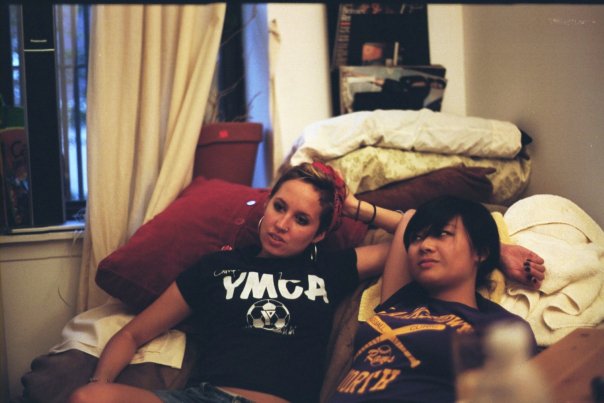


Intern Laura and Hipster-Specialist Katrina 2009

a lesson in hipster history 
 Hipstory, if you will. I know it’s hard to believe that all these thrift store shirt-wearing, gold lamé-legginged girls carry with them any sort of legacy other than ‘80s dance movies (Jennifer Beals, I’m looking at you), but the tale of how the hipster came to be is a history of histories. At the risk of unleashing some violent anti-hipster hatred from a movement which actually meant something — according to one legend, the great ancestor of the lesbian hipster is none other than the riot grrrl. Lesbians and hipsters look alike, they say, because hipsters have evolved from scenesters who were once emo kids, a phenomenon preceded by the re-emergence of punk, influenced of course by riot.
.


lesbian hipster


A more comprehensive look at the composition of typical hipster is recognizing it as a compilation of appropriated cultures, more specifically those that exist not only outside the mainstream, but as a rebellion against it.
“Oversaturation turns the outlandish into the normal and the DIY into the mass-produced.”
It’s all how we cycle “cool.” A subculture creates a style to distinguish itself from the mainstream. These subcultures usually arise from some form of societal oppression, and as women and gays, we are obvs all about oppression.

Once the style becomes distinctive as a symbol of resistance, dissent, or even difference, the mainstream reacts not in fear but instead by picking and choosing what can be reinterpreted and then marketed to the masses as trendy. Oversaturation turns the outlandish into the normal and the DIY into the mass-produced. Suddenly what began as dissent becomes a trend. This sort of appropriation of cultures allows us to buy the edginess of rebellion while bypassing the troubled history.

This edginess is the ‘trend’ — but when the trend fades from the mainstream, those with “genuine” ties to the ethos of the trend often continue on sporting it.

The lesbian hipster, we like to think, is more aware.

hipster as third gender


Despite the fact that, in my opinion, I walk around all day looking like a big giant lesbian with the ability to wear a bandana at least six different ways and a haircut whose tell-tale asymmetry can be spotted by even a novice, I still unintentionally pass as straight. Not just in the way that everyone assumes everyone else’s heterosexuality, but in the way that I can wear a tie, use the word “girlfriend” non-platonically, and still be actively pursued by men.

Perhaps this is due to my extraordinary good looks. But most likely this is due to the fact that hipster style tends to be androgynous. Aside from the ironic mustache (most of the time), most hipster trends are suited to fit both guys and girls. What was once “boys in girl pants” has now just evolved into “skinny jeans,” and any clothing items once sized large enough to fit only men have been shrunken down to skin tight. Hipster seems to be functioning as a third gender in fashion.

It’s not uncommon in many non-Western cultures to recognize third or multiple genders in society, although it makes our government and health care system very uncomfortable. While the third-gendered peoples are generally accepted in these societies, and often were revered as oracles, this acceptance tends to come at the price of their sexuality. Basically, in order to avoid that whole confusion over reproduction and gender binaries and such, these individuals are generally regarded as asexual.

.


But worry not, lesbian hipsters – we still think you’re hot. Hipsterdom may be viewed as somewhere in between genders, but identifying yourself as a lesbian means not only identifying yourself as a woman but also identifying yourself based on sexuality. Therefore, the lesbian hipster has universal appeal. Her style is just new enough to be trendy and sexy, while the items in her wardrobe are familiar enough to be safe.

.
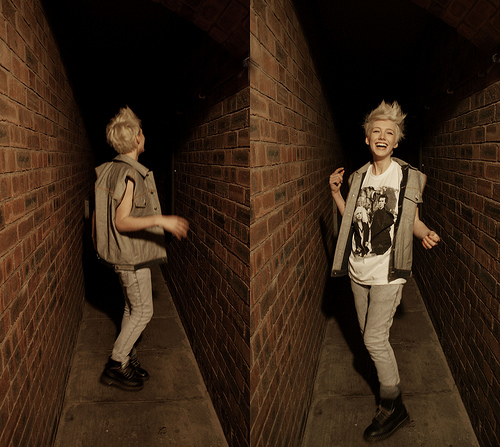
Lesbian Hipster


good music , bad romance 

 As we have seen, empirical research has proven that the hipster lesbian is typically perceived by straight men as “just an edgy straight girl” and by straight women as “that cute lesbian I would totally go gay for.” And that’s all fine and good for walking around all hipster-cool, but what does it mean in the world of lesbian?

“However, dressing like Tegan and Sara does not a trendy lesbian make.”
Once again, we’ve got Tegan and Sara to thank, maybe not exclusively, but definitely largely, for making the lesbian hipster cool. Always appearing with swoopalicious bangs, ankle-choking jeans, and trendy t-shirts, the girls made lesbian hipster not only acceptable, but also attractive. However, dressing like Tegan and Sara does not a trendy lesbian make.

Because let’s face it, y’all: hipsters are sometimes ridiculous. Take it from someone who has actually been turned down for being “just too hipster”: not everyone’s into it. This is potentially because hipsters, like members of any fashion culture or subculture, have the tendency to flock together, which has the danger of breeding a culture of exclusivity. Luckily, the queer girl community holds a stronger bond than the hipster one does, allowing the lesbian hipster to socialize freely among other lesbians. In fact, her obvious appearance as a lesbian may even draw in girls who can easily recognize her – she just shouldn’t expect to pick up all of them.

the lesbian three-piece suit

Lesbian Hipster 
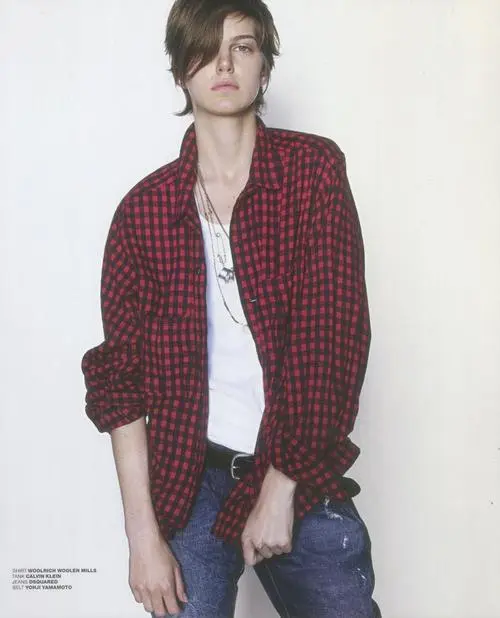
To illustrate this, I present the separate histories of the lesbian three-piece suit: a plaid shirt, a bandanna, and skinny jeans.

1. Plaid Shirt

Don’t you go around calling this lesbian staple your “lumberjack shirt.” Unless, of course, you are a lumberjack, in which case you would probably just call it your shirt. But believe it or not, plaid was once so controversial that English authorities banned the print after the Scottish rebellion in the late 1740’s. Yes, before becoming offensive, Mel Gibson taught us in Braveheart that plaid means business. More recently, you oughta know that plaid shirts were donned by women’s libbers in the ’60s, proving you don’t need to be a man to wear a button-down.

2. Bandana

 Bandanas are so gay that Peaches wrote a song about them. “Hanky Code” poetically weaves the tale of a system of colored handkerchiefs used by gay men in the ‘70s to indicate their sexual preferences and fetishes. And even though bandanas have gone fairly mainstream as a fashion item and are now popular lesbian trademarks, you probably still shouldn’t casually walk into an S&M workshop with a bandana hanging out of your back pocket. Other than that, you go for it, lesbian hipster.

3. Skinny Jeans
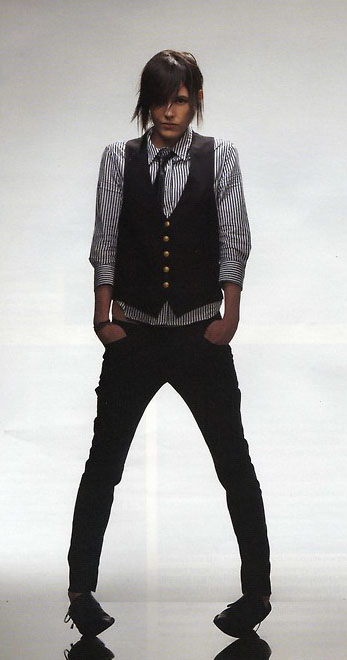
androgyny 

Super-tight straight leg pants, worn notably by sex symbols and rebellious icons Elvis Presley and James Dean, made it big in the 1970s underground punk scene. The pants’ popularity stayed alive through the decades, persisting largely through other music scenes. And although skinny jeans were once – and still are – the choice pants of rock stars and those looking to fight The Man, they have now joined the ranks of the lesbian subculture so that we, too, can experience the awkwardness of trying to hook up, having trouble getting your skinny jeans off, having to hop around the room removing them from your ankles, and finally end up with a pair of inside-out skinny jeans on the floor. Holla.

 Conclusion

 So does the lesbian hipster really exist, and if so, what is her place in the queer girl community? She’s a different kind of lesbian, paying tribute to the subcultures that came before her. Or maybe she’s just a girl who thinks solid-colored v-neck t-shirts maker her look hotter than any other kind (she’s correct).
Androgynously sexy and dykey but not quite butch, the lesbian hipster creates its own categories by falling in between older ones. Hipsters get their clothes from lesbians, and lesbians get their clothes from hipsters; maybe this means there are no lesbian hipsters or even hipsters at all, there are just lesbians, and straight people who dress like them.
We invited the lesbian hipster over, and now she’s here to stay. Perhaps for tea, preferably something trendy like rooibos out of a thrifted 4-H mug. We won’t even kick the lesbian hipster out the next morning. In fact, maybe she can move in. Maybe we can get a cat and name it something like Jane Lynch, or Shane Jr.

“The lesbian hipster style provides for us the perfect outlet for androgyny, which we all already know to be sexy. It’s a middle ground of gender – androgyny is hipsterdom’s gift.”
But really, much to the grievance of heterosexual hipsters, the look will pass. Autostraddle predicts that for gay ladies, however, the trend will stay. It’s the same reason we want the lesbian hipster herself to stay. These trends are giving queer girls what we’ve always deserved: to be hot…on our terms.
The lesbian hipster style provides for us the perfect outlet for androgyny, which we all already know to be sexy. It’s a middle ground of gender – androgyny is hipsterdom’s gift. We can still be girls without having to be too girly. It’s like in the ‘80s when women in the business world adopted power suits, and even when they went out of fashion, lesbians kept them (‘sup Bette Porter). They weren’t our access to power, but they were a sign of our empowerment.

Such is the case for today’s hipster. Dressed once in full hipster clad for church (a different story entirely), my mom told me that I had to change so I could look like a girl. Well, now thanks to hipsters, we don’t have to take it when our moms tell us to look like girls. We already know we’re girls. Nay, we are women (womyn?), and we are so hip and so cool that we don’t need frills or poofs or heels or however they’re selling femininity to us these days. The lesbian hipster is confident; she knows who she is and what she wants, and she’s wearing her little gay heart on her plaid sleeve.


Friday, November 13, 2009

"Coming Out"

Identifying yourself as lesbian, gay, bisexual or transgender (LGBT) and disclosing this to other people is often referred to as 'coming out'.

'Coming out' usually takes place in the early to mid teenage years and is generally a positive experience. However, coming to terms with confusion about identity can affect a young person's social relationships, school work and self-esteem both negatively and positively.

It can be a difficult time for many young LGBT people when they decide who to tell about their sexuality. In making this disclosure they are often fearful of negative reactions, rejection and causing upset and distress to the person they are telling. Sometimes a young person may 'come out' to a supportive teacher or a school friend before talking to parents, in order to rehearse their own part and to judge reactions.

There are several theories about the elements of the 'coming out' process. Each has its own emphasis but all of them are developmental models which regard 'coming out' as a series of stages. These stages do not necessarily last the same length of time and there is no one age when the whole process begins and ends. These stages can be described as follows:

Sensitisation
'I remember feeling very upset when the teacher in our sixth form called me and my friends the 'gay young men'. We were interested in art and hated sport. He thought we were wimps. It is funny, so far about four out of the eight of us have since come out. I don't know whether the teacher knew more about us than we did about ourselves.' Peter
'I felt as if I had nothing in common with people. There was no conversation - I don't like sport, I don't like any of this stuff.' Tom
In this stage a person generally begins to feel 'different' to other people of the same sex. Sometimes they recognise that they are not very interested in people of the opposite sex but more often they feel they are not really interested in things which are supposed to be appropriate for their sex. Most people report just feeling unusual when they compare themselves to other people of their sex. Commonly this happens before or in early adolescence when friendships and relationships between the sexes begin to change.

Confusion about identity
'I didn't even know what a lesbian was. It was a sort of tradition that girls in the lower end of the school had crushes on older girls. They were everything you wanted to be and admired. I did wonder once if my crush was just a bit stronger than it ought have been but I was brought up to believe I would meet Mr Right and settle down to 2.4 kids so I just expected it to go away when we started to go out with boys.' Katie, 21
There are usually four elements which contribute to confusion about identity:

Feeling that perceptions of the self are altering;
Feeling and experiencing heterosexual and homosexual sexual arousal;
Sensing the stigma surrounding homosexuality;
Lacking knowledge about homosexuality.


Research indicates that most young gay men first decide they are probably gay between the ages of 12 and 17, and most young lesbians first decide they are probably lesbian between the ages of 16 and 20. At this time they have to deal with feeling that they have changed, as have their relationships with other people around them. Some also have to combat the potentially powerful feelings of self-recrimination and disgust that come from describing themselves as homosexual. There are various strategies for coping with this emotional upheaval.

Some young people who think they are lesbian or gay will try to deny it to themselves and even seek help to eradicate their feelings. Others will try and avoid thoughts and feelings which remind them that they have homosexual inclinations. In these situations young people can avoid getting any information about sexuality in order to avoid confirming their suspicions about their orientation.

Some young people have great difficulty in managing their relationships with peers and family. They may avoid situations in which they encounter opportunities for heterosexual relationships so that they are not forced to deal with their lack of sexual interest in members of the opposite sex or have it exposed. They may, alternatively, persevere with heterosexual relationships to try and 'convert' themselves and/or conceal their homosexuality from others.

'You'd keep her for a while, just to keep your mates happy. And then after a bit you just dropped her, saying, 'Ah, didn't really like her, broke down. So you constantly went through the heterosexual bit until you found you were strong enough to go out on your own and tell people.' Rod
In some extreme cases young people may try to avoid confronting their feelings by expressing strong homophobia or turning to drink and drugs in order to find temporary relief from them.

Finally, some young people fall back on a strategy of redefining their feelings and behaviour in such a way as to convince themselves that it is not really homosexual. For example, they may describe their experiences as a 'phase' or a 'one-off' or they might put them down to extreme emotional or physical circumstances such as the break-up of a relationship or drunkenness at a party. In this stage feelings are becoming more concrete. Young people may well have partners of both sexes and find their moods and feelings shifting as they feel more or less certain about their identity. This period often lasts throughout adolescence.

Assuming a lesbian or gay identity
Clearly, living with confusion about identity is emotionally exhausting and potentially destructive. For some people this period is followed quite quickly by a stage in which they come to accept their identity and are able to express it in a positive way. For both young men and women growing up mixing with other young gay people - in social settings or through support groups - can help them feel able to accept who they are. For some people, particularly in larger towns and cities, LGBT support groups provide a safe environment for 'coming out'. Elsewhere local and national LGBT telephone helplines provide a listening ear for people who want support.

Commitment
'I think when I fell in love it all became so much more concrete for me. I was suddenly very certain of what I wanted and why I wanted it. I mean, I still found myself thinking every now and then, 'why am I gay?', but I came more and more to think, 'I am gay because I love another man'. And I'm proud of that. I am proud of him and I'm proud of me and I don't care who knows it.' Martin

The final stage in the process of 'coming out' involves becoming openly lesbian, gay, bisexual or transgender and recognising that it is a central aspect of, 'who I am', and, 'how I want to live my life'. People begin to feel that homosexuality is a valid way of life and develop a sense of contentment with being lesbian, gay, bisexual or transgender. They often have the experience of being in a relationship or falling in love at this time and, perhaps as a result, feel more confident, fulfilled and able to combat the social stigma that they may suffer.

At this time some people begin to feel proud of their sexuality. The expression of this pride in being lesbian, gay, bisexual or transgender is a powerful force in challenging the stigma attached to homosexuality by people with prejudiced attitudes and provides positive role models to others less sure about 'coming out'.


Source: http://www.avert.org/coming-out.htm